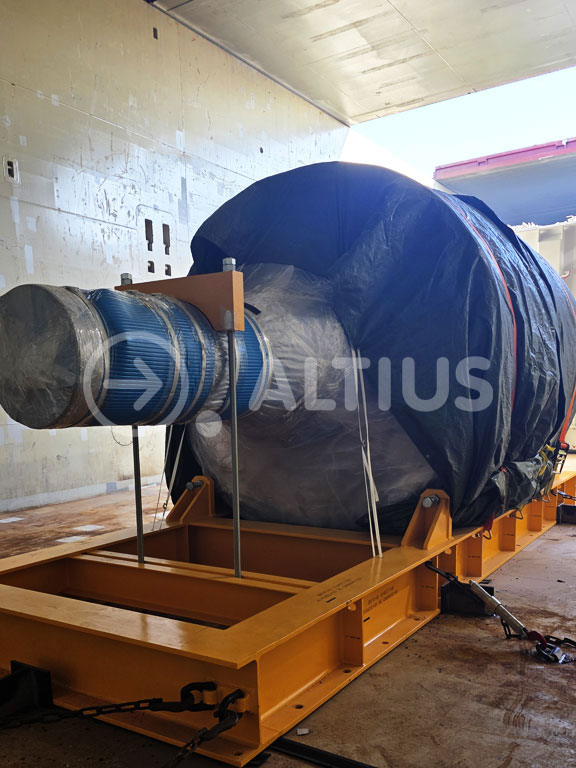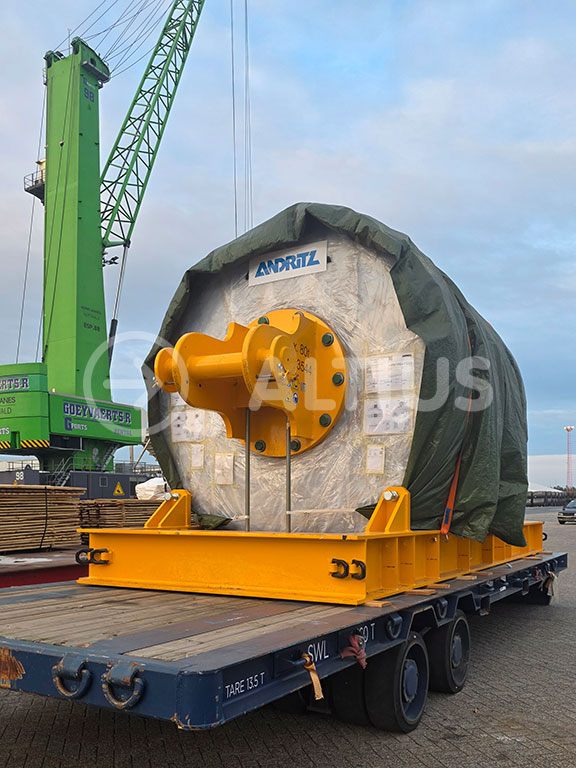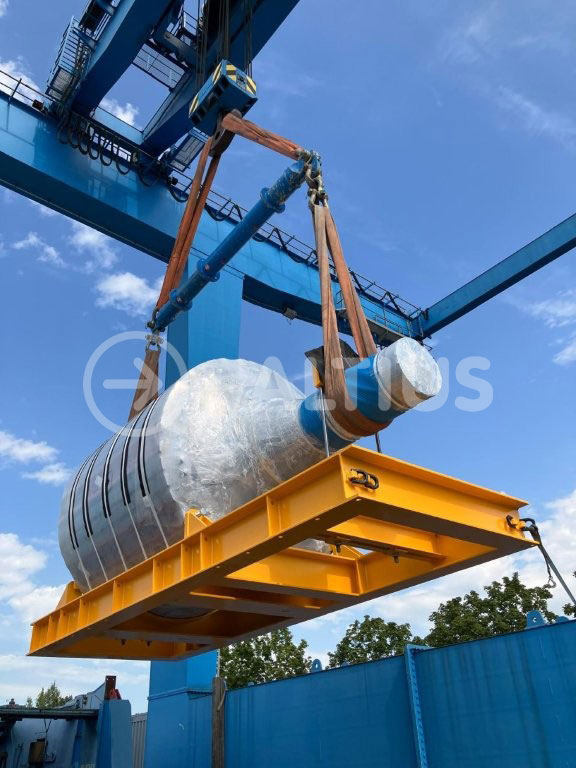
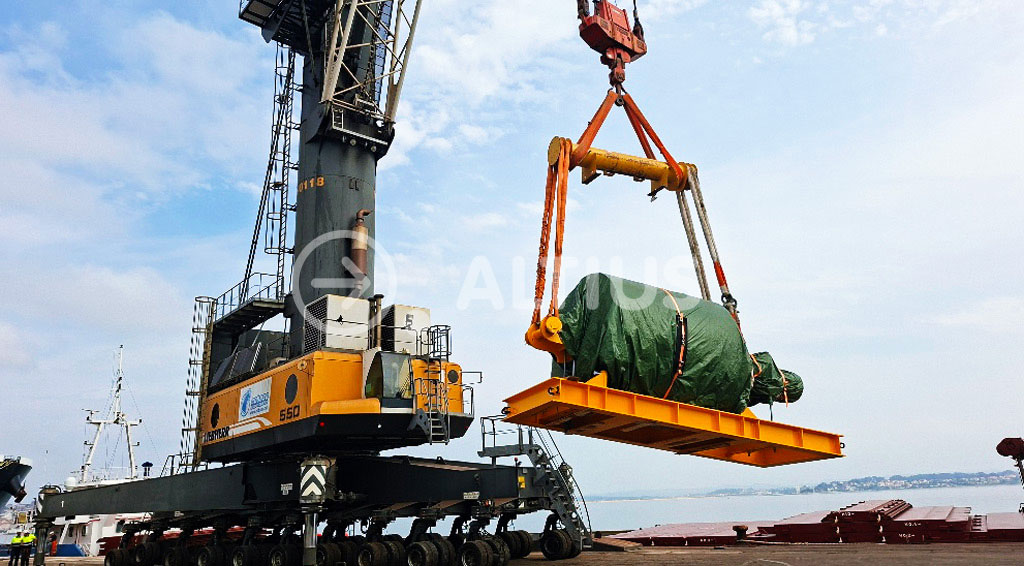
Together with Arbegui, we are moving four rotors from the supplier’s plant in Austria to northern Spain. Two of the four shipments have already arrived at the Port of Santander, one of them with the Rhine and the Danube at historic lows.
At Altius, we coordinated the entire transport operation for four 132-tonne rotors measuring 7.18 x 3.08 x 3.30 m from Linz (Austria) to the Port of Santander. Each rotor travels as a separate shipment: first by barge along the Danube and the Rhine to Antwerp, and then by coastal vessel to Santander. There, we hand it over to Arbegui, our partner on this project, which handles the final road leg to the site and the installation.
The second shipment, loaded in mid-August 2026, sailed during one of the worst droughts in living memory on Europe’s major rivers. It arrived in Santander in late September, without incident.
A multimodal operation from Austria to Cantabria.
Our industrial projects team coordinates each shipment from the supplier’s plant in Linz through to delivery at the Port of Santander. There are five linked phases, and in each one the rotor changes its mode of transport:
- Barge loading in Linz. We load the rotor directly from the supplier’s plant, on the banks of the Danube.
- Inland navigation to Antwerp. The barge crosses the heart of Europe, mainly along the Danube and the Rhine, to the Belgian port.
- Transshipment in Antwerp. We unload the rotor from the barge and load it onto a coastal vessel.
- Sea transport to Santander. Before departure, we calculate and carry out the lashing and securing of the piece to limit any movement and keep it properly secured throughout the voyage.
- Unloading in Santander. We unload the rotor and load it onto Arbegui’s special transport equipment, which takes it to its final destination.
Combining inland waterways and sea transport allows us to move a piece of this size and weight without driving halfway across Europe. The key is ensuring every mode change is planned down to the last detail: a delay in a transshipment impacts the entire chain.
Sailing the Danube and the Rhine with the rivers at record lows.
The second shipment left Linz in mid-August, during a period of exceptionally low levels on the Danube and the Rhine. That summer, Europe’s major rivers recorded their lowest flows in decades: the Rhine fell to 74 cm in Cologne in July, and the Danube dropped below operational limits for deep-draft vessels in some stretches, according to data from the European Commission’s Joint Research Centre.
With less water, a barge carrying 132 tonnes runs the risk of running aground or being forced to stop mid-route. To prevent this, we acted on three fronts:
- We chose a barge with the right draft. We sourced a vessel that, with the rotor on board, could sail with sufficient clearance above the riverbed.
- We monitored water levels at all times. We tracked flow levels daily along each stretch of the route to anticipate any change.
- We kept all parties informed. The client, Arbegui, and the rest of the suppliers knew at all times where the cargo was and what could happen in the days ahead.
The rotor arrived in Santander in late September. When the rivers don’t cooperate, what makes the difference is having a plan, reviewing it every day, and relying on a team that knows each stretch of the route inside out.
The third shipment is scheduled for early 2027, with a fourth still to follow.